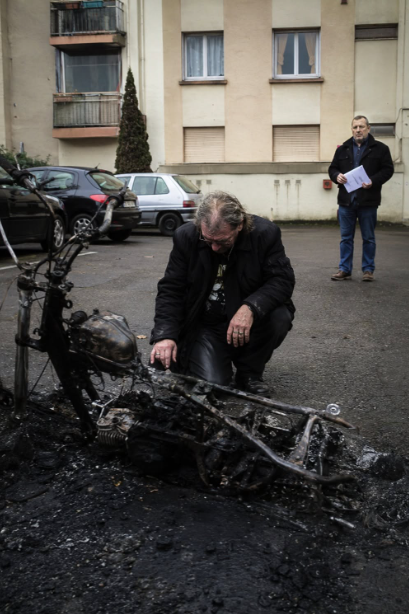
…in violation of the rules!”
A gray-haired man, wearing an old jacket with the words “overseas operation” embroidered on it, stepped forward. It was
Marc.
“No one here is in violation of anything,” he said calmly. “We are visitors. The building’s regulations allow tenants to have guests, don’t they?”
“What tenant? Luc is dead,” the manager retorted, growing increasingly nervous.
I stood up.
“I am,” I said. “I am an occupant—residing here rent-free—and you haven’t followed a single legal procedure for an eviction.”
Just then, a black sedan pulled up near the entrance. A man in a suit stepped out, carrying a briefcase.
“Maître Giraud, attorney-at-law,” he introduced himself. “I represent the estate of Mr. Luc Martin, as well as his brother. We are here to file a formal complaint for destruction of property, harassment, and discrimination against a disabled military veteran.”
Mr. Laurent turned pale.
“Disabled? Come now—he rode a motorcycle!”
Maître Giraud pulled out a neatly organized file.
“A 60% recognized disability rating, stemming from service-related injuries. You repeatedly
denied his requests for a parking space closer to the lobby, despite his medical documentation. It’s all on record.”
Yanis then held up his phone.
“And there’s this, too.” He played a video. It clearly showed Hugo walking across the parking lot carrying a canister, dousing the motorcycle, striking something, and then—flames erupting. In the corner of the frame, the window to Mr. Laurent’s office was visible, illuminated, with his silhouette standing behind the glass. “It’s a setup!” the manager protested, his voice suddenly rising in pitch. “Things like this can be faked in just a couple of clicks!”
A voice trembled from behind him:
“No, Uncle. It’s… it’s true.”
Hugo stood at the entrance to the lobby, deathly pale, one hand gripping the railing. He stared out at the crowd—the phones pointed his way, the jackets worn by former soldiers, the motorcycles. Suddenly, he looked much younger.
“They… they called
the police,” he added, his voice barely audible. “Lots of police.”
As if to confirm his words, two marked police cars pulled up, followed by a fire truck and a vehicle bearing the insignia of the forensic unit.
The lead officer stepped forward.
“We’ve received a complaint regarding arson and destruction of property. Given the estimated value and the danger posed to the residents, this is a serious offense. We will be conducting interviews.”
Maître Giraud held up Luc’s binder.
“The estimated value of the motorcycle is 32,000 euros—with evidence to back it up. There is also a will stating that this asset was bequeathed to his brother.”
As the officers took notes, a figure stepped out from the group of tenants. It was Madame Benali. She was trembling, but her voice rang out clearly.
“I saw everything,” she declared. “The young man took a canister from the maintenance room. Monsieur Laurent knew about it. He didn’t do a thing.”
Monsieur Costa
joined her.
“Luc was a good man. He helped all of us.” “The manager had been harassing him for a long time. He wanted him out so he could renovate the apartment and rent it out for more money.”
Sophie, the nurse, took a deep breath and stepped forward.
“I heard Mr. Laurent say that ‘people like Luc’ scared away good tenants. I thought that was unfair. I’ll testify, too.”
People began to speak up, one by one. The elderly gentleman from the fourth floor, the young mother from the second, the couple from the first. Everyone had a story: the lock he’d fixed, the night he’d called the fire department just in time, the packages he’d taken in for neighbors who worked late.
At that moment, the situation shifted. The police officers handcuffed Hugo, then turned to Mr. Laurent.
“You’re coming with us, sir—for questioning,” the officer said. “Arson committed by an organized group—that’s a serious matter.”
By the time they led him away, that signature smirk of his had long since vanished.
The silence that followed was broken by the sound of an engine being cut, then the sharp tap of a heel against the pavement. A tall man with a salt-and-pepper beard, wearing a leather jacket emblazoned with the words “Brothers of the Road,” looked at the charred remains of the motorcycle, then at me.
“I was the leader of Luc’s riding group,” he said. “To us, he was a brother. That bike—it was his light when everything else was dark. Here’s what we’re going to do: we’re going to rebuild it. Piece by piece, bolt by bolt. We can’t bring Luc back, but we can bring his machine back to life.”
He turned toward me. “And when it’s back on the road, you’ll be the one holding the handlebars. Because that’s what he would have wanted.”
He held out his hand—broad, calloused. I took it.
Beneath my fingers, I felt something solid fall back into place inside me.
It took six months.