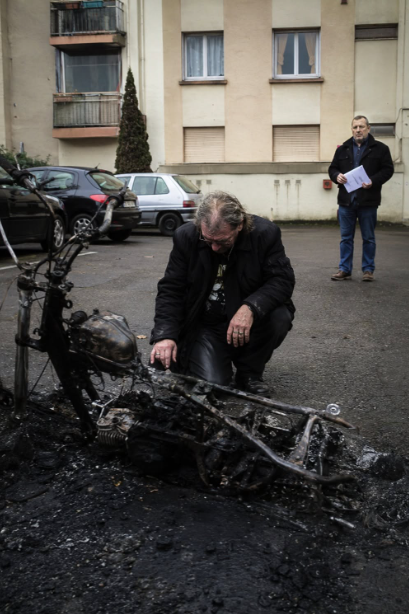
The matter took its course. I won’t go into every detail, but in the end, Hugo was sentenced to community service and ordered to pay compensation to the estate. Mr. Laurent received a stiffer, suspended sentence; he lost his position as manager and is now barred from managing any residential property for several years.
But for me, the real story was unfolding in an old garage, lent by a member of the “Brothers of the Road” motorcycle club.
Luc’s old army buddies tracked down period-correct parts from all over France—a fender in Lille, a fuel tank near Marseille, a set of handlebars from a small swap meet in Brittany. We’d exchange photos and spend hours debating the exact shade the bike should be restored to.
Every weekend, they
would show up. We’d take things apart, clean them, and make adjustments. They taught me how to tune a carburetor, tighten a chain, and listen to the way an engine breathes. We laughed, sometimes we cried, and often we worked in silence—each of us lost in our own memories.
The neighbors would stop by, too. Mrs. Benali would bring couscous for everyone; Sophie would bring tarts. The children painted a banner that read, in clumsy, hand-lettered script: “Luc’s motorcycle will live again.”
Meanwhile, the apartment complex had a new manager: Mrs. Leroy, a woman in her forties with glasses perched on her nose and a direct, honest gaze. Shortly after she took over, she called me into her office.
“I’ve read the file,” she said. “What happened is unacceptable. If you’d like, we can put the lease in your name, under the same terms your brother had. And as for the parking space…”
She smiled. “I’ve changed the plan. Your spot
will now be right in front of the entrance. According to his letters, this is what Mr. Martin had been asking for for years. He should have had it while he was still alive. We can at least set that right.”
The day we finally closed the last engine cover and tightened the last screw, the garage was packed. There were former soldiers, bikers, neighbors—people who had simply heard about “the story of the burnt-out motorcycle.” Even a few police officers who had followed the case showed up, in plain clothes.
We wheeled the bike outside. It gleamed under the gray sun of that late afternoon, even more beautiful than I remembered. It wasn’t brand new: in certain lights, you could still see faint traces of the fire—scars that hadn’t completely faded. They suited it well.
We waited a moment. Everyone held their breath.
I turned the ignition.
The big, bearded man signaled to me.
“Go ahead. It’s yours now.”
I pressed the starter.
At first, there was just a sputter. Then another. And suddenly, a deep rumble filled the courtyard—the kind of sound you feel in your chest. The children cheered, and some of the adults did too. Mrs. Benali wept, making no attempt to hide it. Mr. Costa stood at attention, albeit a bit awkwardly. Sophie whispered:
“He’d be proud, up there.”
That day, I took my first ride on Luc’s motorcycle.
I was wearing his old leather jacket—a bit worn at the elbows—and his military dog tags beneath my T-shirt. The motorcycle moved—lively, stable—as if it had been waiting all this time for just this moment.
We rode around the neighborhood. People at their windows waved; some called out my brother’s name.
A few months later, in the parking space right
in front of the building entrance—the very spot where the motorcycle had burned—a small, understated plaque was fixed to the wall.
It read:
“In memory of Luc Martin (1969–2023)
Brother, neighbor, former soldier.
He helped far more people than he ever realized.”
The motorcycle is parked there almost every evening. Sometimes, I find a small bouquet of flowers resting on the seat. Sometimes, there’s a folded note tucked under the elastic strap on the instrument panel: “Thank you for the night you walked me home,” “Thank you for the library you set up in the basement,” “Thank you for listening to my father on the bench in front of the building.”
One day, Madame Benali’s granddaughter gave me a drawing: her grandfather, sitting on Luc’s motorcycle, wearing a superhero cape. I smiled when I saw it and tucked it into my wallet. It’s still there.
They thought they could erase my brother by burning the things he
loved. In reality, they created a living monument. They imagined that a charred motorcycle would simply fade into oblivion. Instead, it brought an entire neighborhood together.
All because one man, for years, had chosen to be of service rather than to complain.
Every Sunday, I follow a little ritual.
I start up the motorcycle and head first to the cemetery, to say hello to Luc. Next, I pass by the small veterans’ association where he used to volunteer. Then, I finish up at the residential complex. Children are playing with a ball in the courtyard.