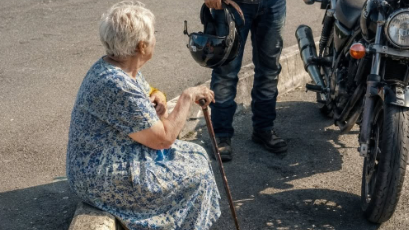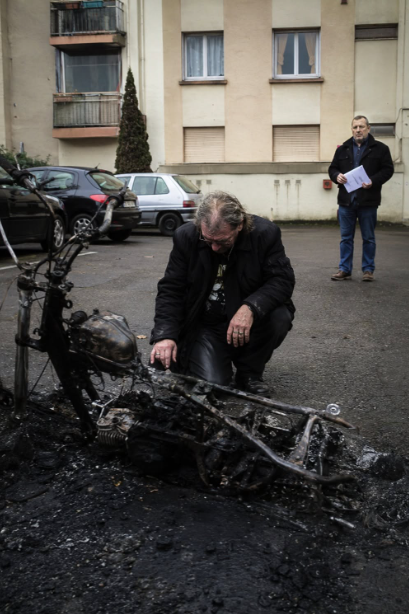
…not them. My two little ones live with me. If he kicks me out, where am I supposed to go? To a homeless shelter? I… I’m sorry.”
She hurried away, almost running, leaving me alone with the remains of the motorcycle and a silence that felt even heavier.
That night, I slept—or rather, tried to sleep—in Luc’s apartment. His scent still lingered, mingled with the smell of cold coffee and chain oil. I opened his cupboards the way one might open
a black box after a crash.
His old army uniform, carefully folded inside a garment bag. Photographs of him and his comrades in fatigues, somewhere under a scorching sun. His early retirement papers due to disability. A medical report confirming a cancer diagnosis. And a thick binder labeled “MOTORCYCLE.”
Inside, everything was there: receipts for every single part, photos taken at each stage of the restoration, and printed appraisals showing the bike’s value—32,000 euros, in black and white. And, tucked into a plastic sleeve, a document I had never seen before: a will, dated three weeks earlier, in which Luc had written—in a slightly shaky hand—that the motorcycle was to go to me.
“Because you’re the only one who understands what it means to me,” he had added by hand at the bottom of the page.
The next morning, I
started making calls.
To the men from Luc’s old regiment. To his friends from his motorcycle club, “Brothers of the Road,” with whom he used to ride before his illness wore him down. To the veterans’ association where he used to lend a hand. Word of mouth did the rest. Around noon, there was a knock at the door. It was him again—Mr. Laurent.
“Just a reminder,” he said, skipping any pleasantries, “this parking lot isn’t a junkyard. You need to remove that wreck; it’s upsetting the other residents.”
“It’s not a wreck,” I replied. “It’s a crime scene.”
He burst out laughing.
“A crime scene? Come on, be serious. You’ll never be able to prove anything. Take my advice: get it removed, and that’ll be the end of it. Otherwise, I’m calling the police.”
“Go ahead and call them,” I said. “I actually intend to file a complaint myself.”
His smile tightened, just a fraction.
“Look, we can work something out. Clear the parking lot, and you can stay in the apartment for another twenty-four hours. After that, I’m initiating formal proceedings.”
What he didn’t know was that among Luc’s old friends were Marc—now a private investigator—and Yanis, who worked in cybersecurity. And the “Road Brothers” happened to know people in just about every profession imaginable.
In less than a day, they had followed several leads.
Marc uncovered a trail of registered letters in which Mr. Laurent had spent months pressuring certain tenants to leave—citing “renovation work”—always targeting the longest-term residents, those who paid lower, protected rents. Luc, with his solid lease and modest, rent-controlled rate, was a thorn in his side.
As for Yanis, he handled the digital side of things. He managed to track down the account belonging to Hugo, the nephew. On his social media, the boy had filmed himself on the night of the fire; the video showed, however vaguely, flames at the back of the parking lot, accompanied by the caption: “One less trash bin in the apartment complex.” He deleted the post the following morning, but on the internet, nothing ever truly disappears. Yanis managed to recover a copy, along with the metadata.
More importantly, a security camera from a small shop next to the complex—positioned with a clear view of the parking lot entrance—had captured everything: Hugo walking across the lot carrying a jug, the fire igniting, and, in the illuminated window of the office, the motionless silhouette of Mr. Laurent.
The next day—which, according to his letter, was to be my final permitted day in the apartment—I sat down beside the charred remains of the motorcycle. I placed Luc’s binder next to me, like a file waiting to be opened.
That was when I heard the first engines.
These weren’t the cars of the residents. The sound was deeper,
and there were many more of them. Within minutes, the street was filled with vehicles—motorcycles, of course, along with unmarked sedans and utility vans. Many bore “Veteran” stickers, while others displayed the logo of an organization that supports wounded service members. Some even sported the subtle patch of the “Brothers of the Road.”
They parked wherever they could: along the curb, in any available parking space, and a bit further down, in front of the public square. In less than an hour, about a hundred people had gathered, standing around the pile of blackened metal. Men and women—young and old alike—all sharing the same determined look.
Mr. Laurent burst out from the building’s lobby, looking ashen.
“What on earth is this?” You have no right to invade my residence like this! This is private property; you are all…