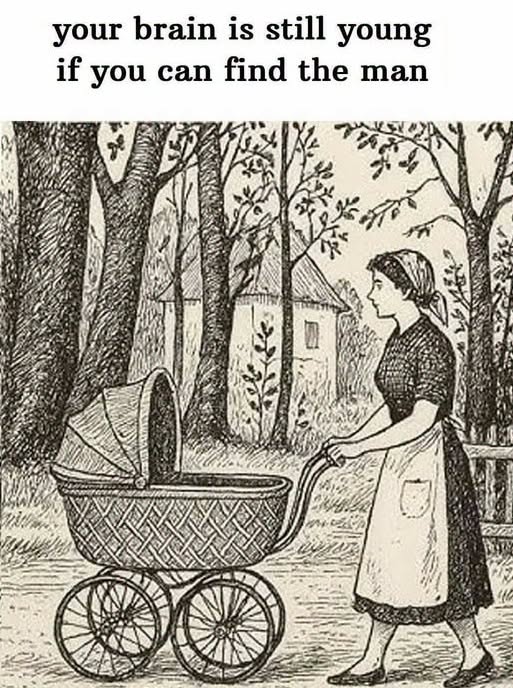
No, a hidden-picture puzzle like this is not something only young eyes can see. It is better understood as an optical illusion and attention puzzle: the man is difficult to notice because the drawing encourages you to organize trees, clothing, stroller shapes, and background lines into an ordinary park scene first. Once your attention shifts, the hidden figure often becomes obvious. That surprise is the point of the format, not evidence that the viewer passed or failed an age test.
The popular caption usually matters as much as the picture. Phrases such as “only young eyes” create urgency, invite comparison, and make people more likely to comment before they have calmly inspected the image. A useful response is to treat the picture as a small lesson in perception and media literacy: what you see first is not always everything that is there, and what a post claims about your result may be much less reliable than the puzzle itself.
This is the woman-with-a-pram illustration
The specific drawing shows a woman pushing a pram among trees. The intended hidden figure is not confirmed by a marked answer key in the available copy. The tree spaces, pram canopy and large outlines are places to inspect, but they should not be advertised as a verified reveal. This image cannot distinguish a young brain from an older one.
What the picture is really asking you to do
The scene described in the viral prompt is a familiar kind of hidden-picture illustration: a woman walking outdoors with a baby stroller, trees in the background, and a concealed male face or figure worked into the shapes around her. The challenge is not simply sharp eyesight. It asks your brain to switch from reading the drawing as a normal scene to reading it as a pattern of outlines, shadows, and negative space. MIT OpenCourseWare’s introductory psychology material frames vision as a process that has to solve interpretive problems, not as a passive copy of the world in front of us
That is why two people can look at the same image and report different first impressions. One person may lock onto the stroller and the path. Another may notice the spacing of branches or the curve of a coat. Neither response proves that one viewer has a better mind or better character. It usually means their attention landed on different cues. In laboratory research on illusory shapes, attention can affect how the visual system responds to implied forms that are not drawn as complete objects
- Start wide: look at the whole image before hunting for details.
- Check the edges: hidden figures are often built from tree lines, clothing folds, or background gaps.
- Look for negative space: the blank area around objects can form part of a face or body.
- Change distance: step back or reduce the image size so small marks merge into larger shapes.
- Pause the caption: ignore the claim about age or intelligence until you have inspected the picture yourself.