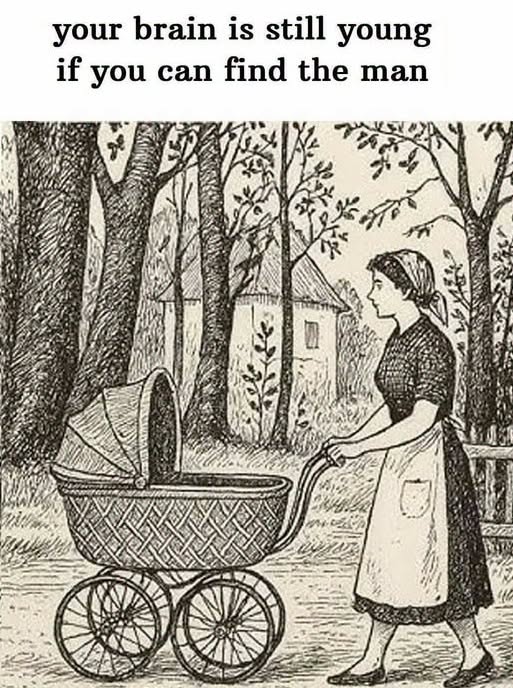
Why the hidden man may appear suddenly
Hidden-picture illusions often feel strange because the answer can arrive all at once. Before you see it, the picture seems ordinary. After you see it, the hidden form may feel impossible to unsee. This shift happens because perception is organized. The same line can be treated as a tree branch in one moment and the edge of a face in the next. The physical pixels or printed marks do not change; your interpretation of how they belong together changes.
This is also why giving someone the answer too early can spoil the puzzle. A clue changes the search. If someone says “look near the trees” or “turn the picture in your mind,” your attention becomes guided toward features you previously treated as background. The viral caption does a less helpful version of that by telling viewers who should be able to see the man, rather than telling them how to inspect the picture. It turns a perception game into a status game.
Does age matter at all?
Age can matter for real visual tasks, but the viral claim is much stronger than the evidence a single puzzle can support. The National Eye Institute notes that vision can change as people grow older, and its age-related vision materials are meant to help people understand ordinary changes and eye care decisions https://www.nei.nih.gov/about/education-and-outreach/outreach-materials/everyones-vision-can-change-age. That does not mean a social media drawing can sort viewers neatly into young and old, or into capable and incapable.
A hidden man in a vintage illustration depends on many factors besides age: screen brightness, image compression, whether the post cropped the original, contrast settings, glare, font overlays, fatigue, patience, and whether the viewer already knows the puzzle’s trick. A person with excellent sight may miss the figure because the scene’s story pulls attention elsewhere. A person who usually struggles with small print may find it quickly because they happen to notice the right outline first.
The media-literacy lesson behind the puzzle
The safest way to enjoy a viral optical illusion is to separate the puzzle from the claim attached to it. Cornell University Library advises readers to pause before sharing emotionally charged posts and to use lateral verification when checking information online https://www.library.cornell.edu/about/news/getting-your-facts-straight-tips-on-media-literacy/. A hidden-picture post may not be dangerous, but it uses the same attention economy as more serious misleading content: it pushes people to react quickly, compare themselves with others, and share before verifying.
For this topic, verification does not mean proving the hidden man is real in a scientific sense. It means asking modest questions. Is the image complete or cropped? Is the caption making a claim the picture cannot support? Is the same image circulating with different age ranges or different answers? Is a page using the puzzle mainly to drive comments, clicks, or redirects? Those questions keep the experience playful without letting the caption overstate what the puzzle shows.
The University of Illinois Library’s guidance on evaluating information emphasizes questions about authorship, purpose, audience, evidence, and publication context https://www.library.illinois.edu/global/global-studies-library-services/global-studies-class-and-subject-guides/evaluating-information/. Those habits apply even to light content. If a post claims that one picture reveals your age, intelligence, personality, or hidden ability, the burden is on the post to support that claim. Most viral puzzle captions do not.
How to look for the man without overthinking it
Begin by relaxing your search. People often miss hidden figures because they stare too hard at the most obvious subject. In the park-scene version, that subject is the woman and stroller. Let your gaze drift to the surrounding shapes. Trace the tree trunks, the spaces between branches, the line of the path, and any dark-light boundary that could double as a profile. If the man is built into the background, he may appear as a face, a bust, or a figure whose outline borrows parts from several objects.
Try changing scale. On a phone, hold the device farther away or briefly view the image as a thumbnail. On a computer, zoom out, then back in. Some hidden images are easier to notice when small details blend together. Others need close inspection because the figure is tucked into a corner. If one approach fails, switch approaches instead of assuming you cannot see it.
Finally, compare interpretations gently. If someone else sees the man first, ask where their eyes landed. If you see it first, describe the location without turning it into a test. These puzzles work best when they become a shared observation exercise. They become less useful when they are used to embarrass people or to make unsupported claims about age.
Why the caption is more suspicious than the drawing
The drawing itself can be clever, charming, and worth enjoying. The caption is the part that deserves skepticism. “Only young eyes” is a classic engagement hook because it invites immediate self-testing. People want to know whether they are in the successful group. That feeling can make them spend longer on the post, tag friends, or argue in the comments. The result is more engagement for the publisher, even if the age claim is not meaningful.
A more accurate caption would say something like: “Can you find the hidden man in this old-style park drawing?” That version still invites curiosity, but it does not pretend the puzzle has diagnostic power. The difference matters because many viral visual posts use exaggerated framing. Some are harmless puzzles. Others use the same style to push misleading claims about bodies, relationships, crime, or public events. For another example of why visual claims need careful framing, see
What a missed illusion does and does not mean
Missing the hidden man means you missed a hidden man in one image under one set of viewing conditions. That is all. It does not prove that you are old, careless, unintelligent, or unable to notice details. Perception is selective by design. If your brain treated every branch, shadow, and contour as equally important all the time, ordinary scenes would be exhausting to interpret. The same selectivity that makes hidden images tricky also helps people move through daily life without being overwhelmed by every possible pattern.
If you want to use the puzzle constructively, ask what changed between not seeing and seeing. Did you step back? Did someone give you a location clue? Did the face appear only after you ignored the stroller? That small reflection is more valuable than the caption’s age claim because it teaches you something about attention. It also builds a habit that transfers to more serious online content: before accepting the first interpretation, slow down and inspect the frame.
A better way to share puzzles like this
When sharing a hidden-picture illusion, keep the fun and remove the pressure. Say what the viewer is looking for, avoid claims about age or ability, and make room for people who need a hint. If the image is old, altered, or reposted from an unknown source, avoid presenting it as a proven test. A good puzzle can still be entertaining without pretending to measure something personal.
That approach makes the puzzle more inclusive and more accurate. It lets younger and older viewers participate without being ranked. It also models a healthier habit for social feeds: curiosity first, claims second, verification before sharing. In that sense, the hidden man is not just a figure in a drawing. He is a reminder that the first story an image tells is not always the only story available.
Conclusion
The hidden man puzzle is best read as an optical illusion and media-literacy exercise, not an age test. The drawing works because ordinary scene details can be reorganized into a concealed figure once attention shifts. Age-related vision changes are real, but a single viral image cannot measure them. Look calmly, change distance, inspect negative space, and be skeptical of captions that turn a playful puzzle into a personal verdict.
Frequently Asked Questions
Is the hidden man puzzle really only for young people?
No. The phrase is a viral hook, not a reliable measurement. Seeing the hidden man can depend on attention, image quality, contrast, screen size, clues, and patience.
Where should I look first in this kind of picture?
Start away from the obvious subject. In a park scene, inspect tree trunks, branches, shadows, the path, and the spaces around the woman and stroller. Hidden figures are often assembled from background lines.
Why can I see the man after someone points him out?
A clue changes how your attention groups the image. Once the hidden outline becomes a meaningful figure, your brain keeps organizing those lines that way, which makes the answer feel obvious afterward.
Can an optical illusion test eyesight?
A casual online illusion cannot judge eyesight. It may reveal something about attention in that moment, but real concerns about seeing clearly belong in a proper eye-care conversation.
Should I share posts that make claims about age or intelligence?
You can share the puzzle for fun, but avoid repeating unsupported claims as fact. A better caption is simple: ask whether people can find the hidden figure and offer a hint if they want one.